You have a project sitting on your desktop right now.
It's the outline for a publication, a business proposal, a strategic shift in your career, or a creative campaign. You claim you want to finish it. You talk about it, plan for it, and put it on your task manager at the start of every week.
Then 5:00 PM arrives, and you haven't touched it.
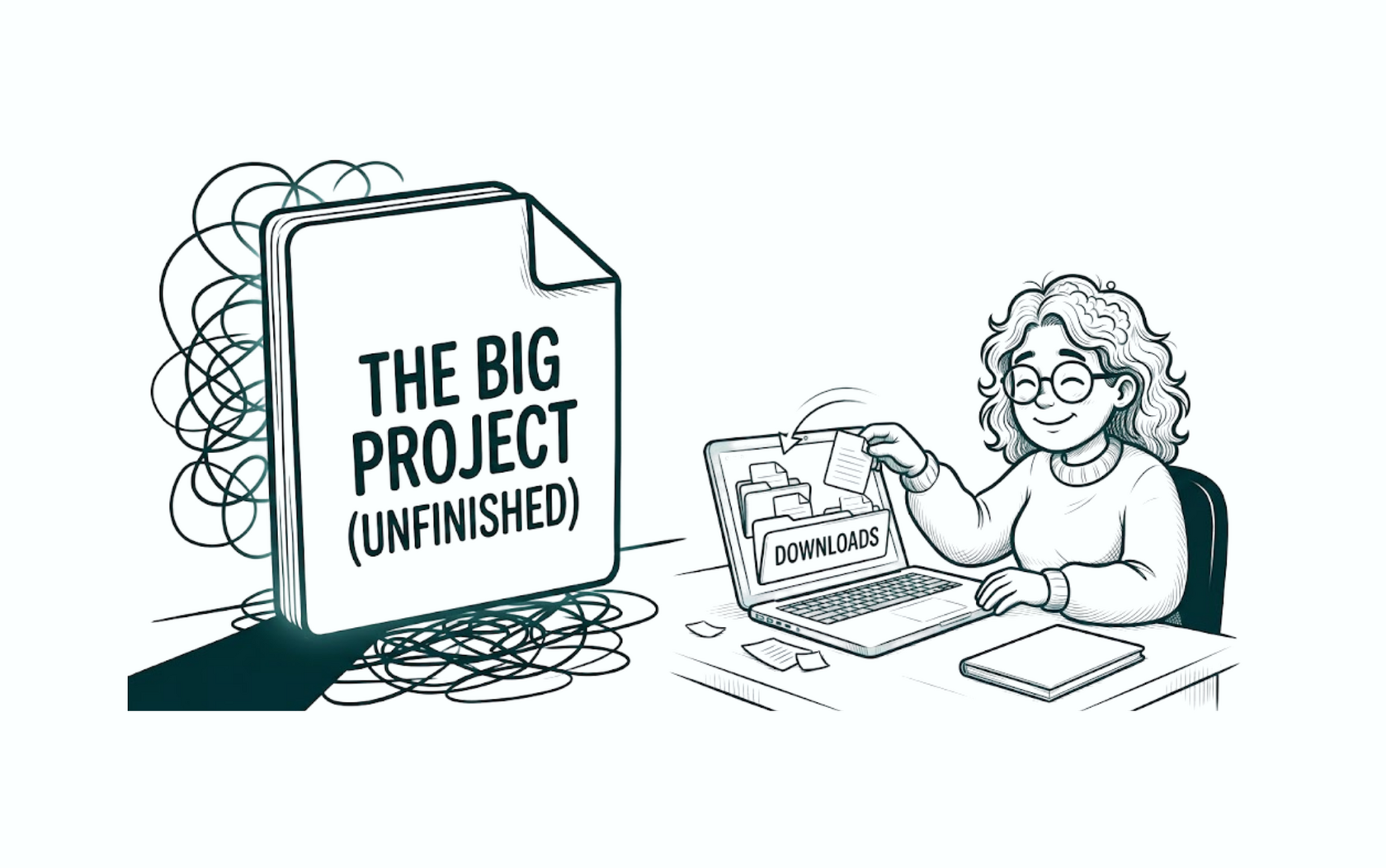
Instead, you answered 40 low-priority emails, reformatted a Notion workspace, organized your downloads folder, and felt metabolically exhausted by dinner.
We call this bad time management or a lack of discipline. We beat ourselves up, promise to white-knuckle through it tomorrow, and repeat the cycle next week.
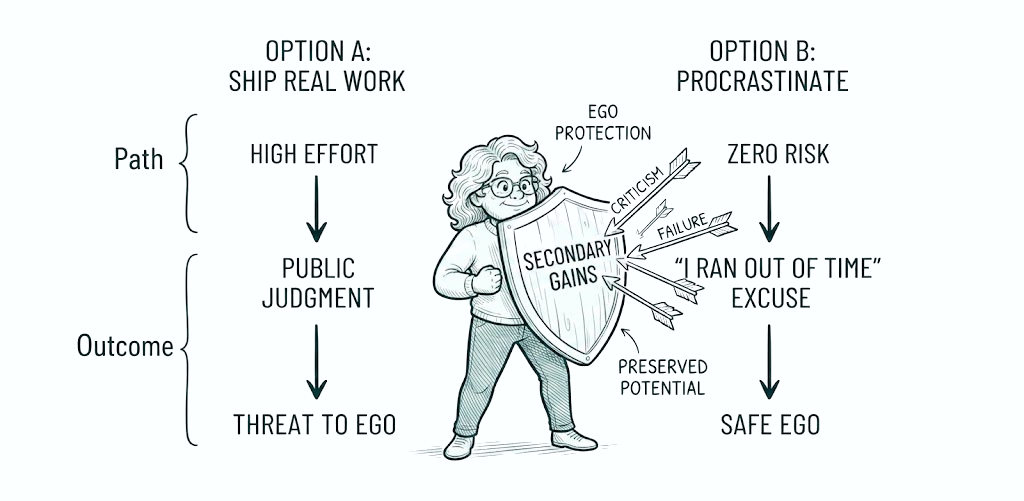
Psychology and neuroscience show a different story: avoidance is rarely an accident. It's an active protective shield. Your brain isn't failing to execute; it's successfully protecting your ego from what it perceives as an existential threat.
Here's the behavioral mechanics behind why we sabotage our own ambition, backed by research, and how to rewrite the default protocol.
1. The Cost of Open-Ended Goals (The Zeigarnik and Ovsiankina Effects)
In the late 1920s at the University of Berlin, psychologist Kurt Lewin and his graduate students began investigating how people process unfinished activities. The line of inquiry started from a casual observation in a Vienna restaurant, where Lewin noticed that waiters could remember complex, unpaid customer orders with complete accuracy, but the moment the bill was paid and the task reached closure, the order vanished entirely from their memory.
Intrigued by this, researcher Bluma Zeigarnik designed a controlled laboratory experiment. She gave participants a series of short tasks like solving puzzles or stringing beads. During roughly half of the assignments, participants were quietly interrupted by the experimenter before they could finish. When interviewed afterward, participants recalled the interrupted tasks nearly twice as often as the completed ones. Zeigarnik's published findings (Zeigarnik, 1927) proved that unfulfilled actions create a state of sustained cognitive tension in the brain.
Taking this research a step further, fellow researcher Maria Ovsiankina investigated what people actually do when faced with those incomplete loops (Ovsiankina, 1928). In her doctoral experiments, Ovsiankina demonstrated that when individuals are interrupted during a task and later given unstructured free time, they display an overwhelming, spontaneous urge to return to and finish that exact interrupted task. Her work proved that an open task generates a psychological "quasi-need," a persistent mental itch that drives us back toward completion.
So why does this mechanism fail when it comes to high-stakes personal goals?
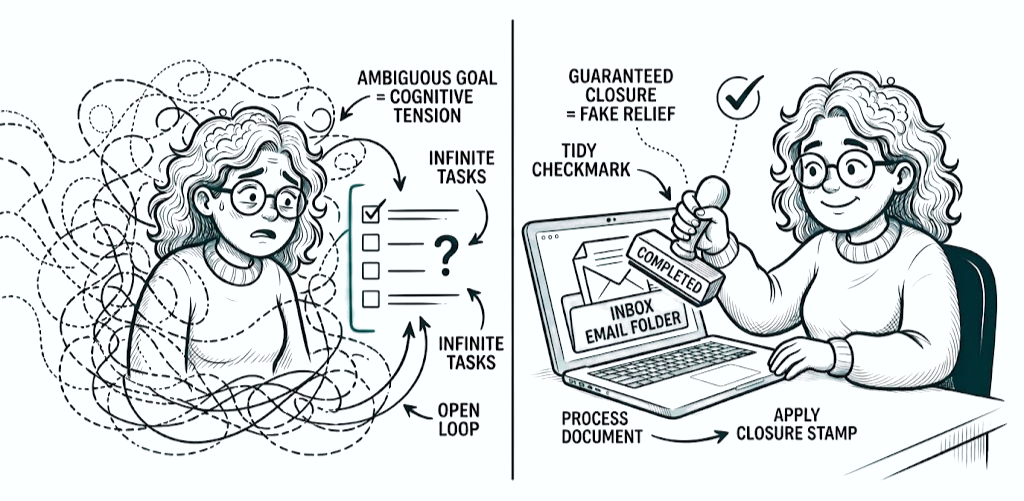
The problem is ambiguity.
When a project is open-ended, when there's no rigid boundary, no clear stopping point, or no defined constraints, your nervous system can't calculate a safe completion path. Instead of leveraging task-completion momentum, the brain perceives an endless, uncontainable drain on cognitive resources.
To resolve the mental tension without taking the risk of failure, your brain picks a task with immediate, guaranteed closure: clearing your inbox, organizing your desk, or tweaking a logo color. You get the dopamine hit of closing a loop without putting your ego on the line.
2. The Dopamine Trap of Anticipation
In the late 1990s, neuroscientist Robert Sapolsky conducted landmark studies on dopamine release in primates (Sapolsky, 1996). The common assumption was that dopamine spikes when a reward is received. Sapolsky found the opposite: dopamine spikes during the anticipation of the reward, not the reward itself.
When you buy a new book, sign up for an expensive course, or buy a domain name for a new project, your brain floods with dopamine. At that exact moment, as far as your neurochemistry's concerned, you've already achieved the transformation.
Wanting the thing is safe, chemically rewarding, and risk-free.
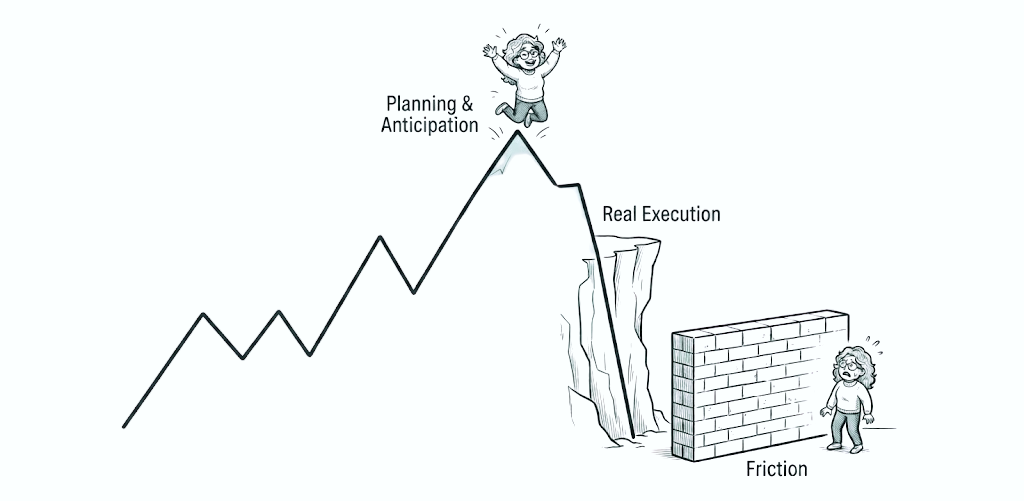
Doing the thing, however, introduces reality. The moment you start writing, building, or executing, the messy friction of reality collides with your idealized vision. The dopamine drops, the cognitive effort spikes, and your brain signals an immediate urge to pivot back to something safe.
3. The Hidden Defense of Secondary Gains
In clinical psychology, a secondary gain is an unintended benefit derived from a negative condition. Procrastination and self-sabotage are loaded with secondary gains that high achievers rarely admit to themselves:
- Ego Protection: If you put off a project until the last 12 hours and it turns out mediocre, you can tell yourself, "I just didn't have enough time." If you give it 100% of your focus over 3 months and it fails, you've got to face the terrifying possibility that your best work wasn't good enough.
- Preserving Potential: As long as the project remains an idea on your hard drive, it retains infinite potential. It could've been world-class. The moment you publish version 1.0, it becomes a real, flawed asset open to public judgment.
- Managing Capacity: Subconsciously, your nervous system knows that succeeding at a new level will bring higher expectations, heavier responsibilities, and greater visibility. Delaying execution keeps your personal environment predictable.
Your brain calculates these secondary gains automatically. If the psychological cost of judgment or effort outweighs the immediate benefit of starting, your nervous system chooses safety every single time.
4. Rewriting the Execution System
You can't outthink a biological defense system using willpower. To move from resistance to execution, you've got to lower the activation energy so drastically that your brain no longer registers the task as a threat.
- Enforce Monastic Time Blocks: Give open-ended projects rigid, artificial containers. A 45-minute timer with zero tabs open removes the cognitive overload of an open-ended goal.
- Separate Ideation from Execution: Never sit down to write, build, or record without an existing outline or low-fidelity draft. Making decisions about what to do while trying to do it burns out your brain before you even start.
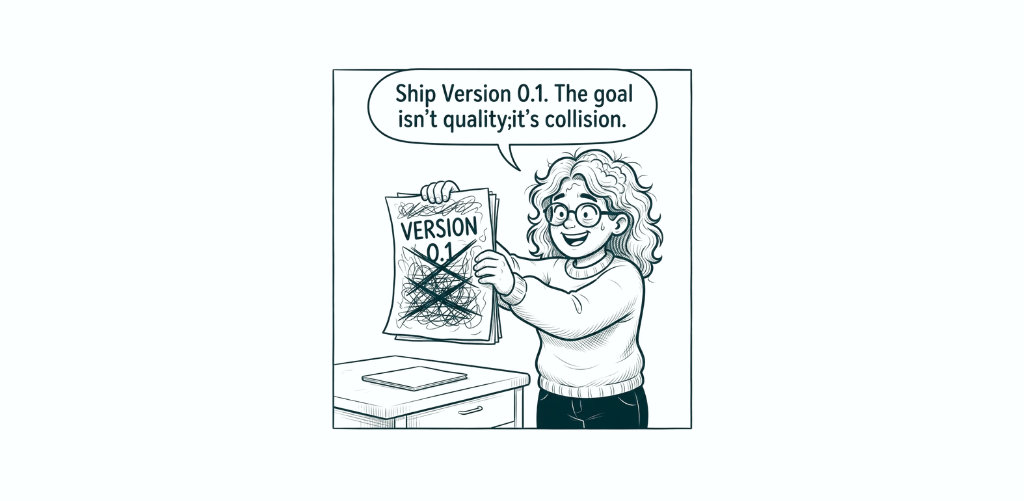
- Ship Version 0.1: The goal of your first session isn't quality; it's collision. Get the idea out of your head and onto the page in its ugliest, most unrefined state. Once an idea becomes a tangible object outside of your mind, it loses its status as an existential threat.
Execution isn't about working harder or pushing through burnout. It's about understanding the biological machinery running under the hood, and building default systems that make action easier than avoidance.